
SHS
AI and Humans: What Balance for the Future of Work?
On this page
By Fanny Pineau
Fanny Pineau is a scientific analyst at F.initiatives and a graduate of IHEAL in the humanities and social sciences.
Artificial intelligence is gradually becoming embedded in most professional environments—scientific research, industry, healthcare, finance, and public administration—profoundly transforming interactions between AI systems and human workers.Decision-support systems, predictive analytics, and cognitive automation tools are increasingly part of workers’ everyday activities.
However, recent scientific literature highlights a paradox: improvements in the technical performance of AI systems do not automatically resolve organizational challenges. On the contrary, the more autonomous these systems become, the more central the question of the human role becomes.
The issue is therefore no longer purely technological. It is now cognitive and organizational: how can complex tasks be automated while preserving workers’ decision-making capacity, learning, and engagement?
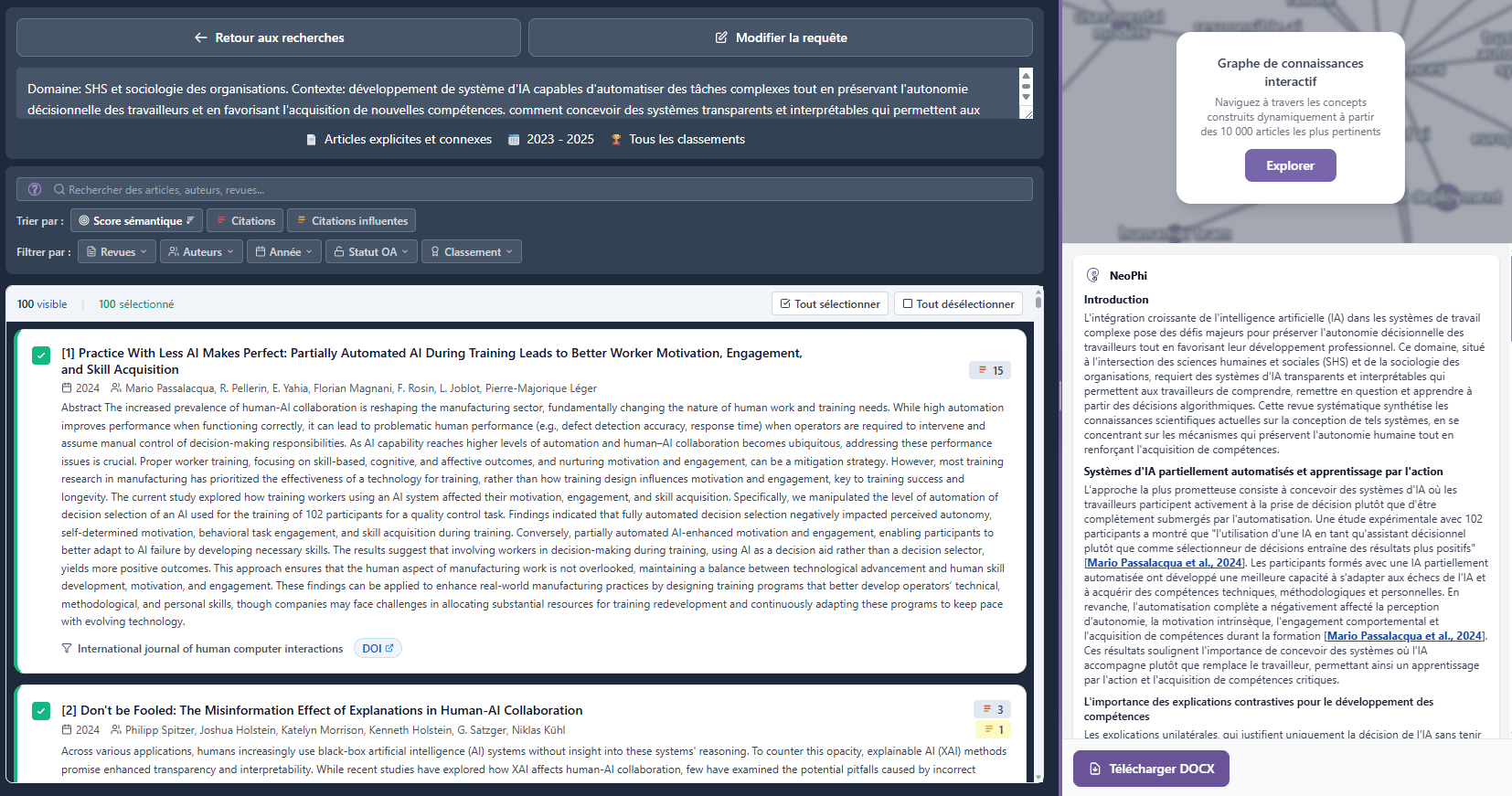
To analyze this question, we conducted a scientific literature review assisted by NeoPhi. The platform allows users to query a large academic corpus (Semantic Scholar) using natural-language research questions, then identify and structure relevant publications.
The publications cited in this article were identified through a query focused on designing AI systems capable of automating certain tasks while preserving decision autonomy and skill acquisition.
The Evolution of Work in the Age of Artificial Intelligence
Recent studies show that AI does not only transform tools — it transforms the organization of work itself. Researchers now refer to socio-technical systems, in which technologies, organizational structures, and human behaviors interact closely (Parker et al., 2023).
The introduction of algorithmic systems changes how individuals perceive information, analyze situations, and make decisions. Work increasingly becomes an activity of supervision, interpretation, and correction of machine-generated recommendations.
The literature shows that organizational performance depends less on the level of automation than on how AI is integrated into human activity.
Productivity and AI Deployment: New Challenges for Organizations
Contrary to a common belief, productivity does not depend directly on the level of automation. Several studies show that gains appear when the user remains involved in the decision-making process (Garibay et al., 2023).
Full automation can reduce human vigilance. Operators tend to supervise less actively a system they perceive as reliable, which delays the detection of errors. Conversely, decision-support systems, in which AI suggests but does not decide, tend to improve overall performance.
AI and Employee Well-Being
Research in work psychology highlights mixed effects. Automation can reduce physical workload and repetitive tasks, but it may also decrease the sense of usefulness and worry employees, or even create resistance.
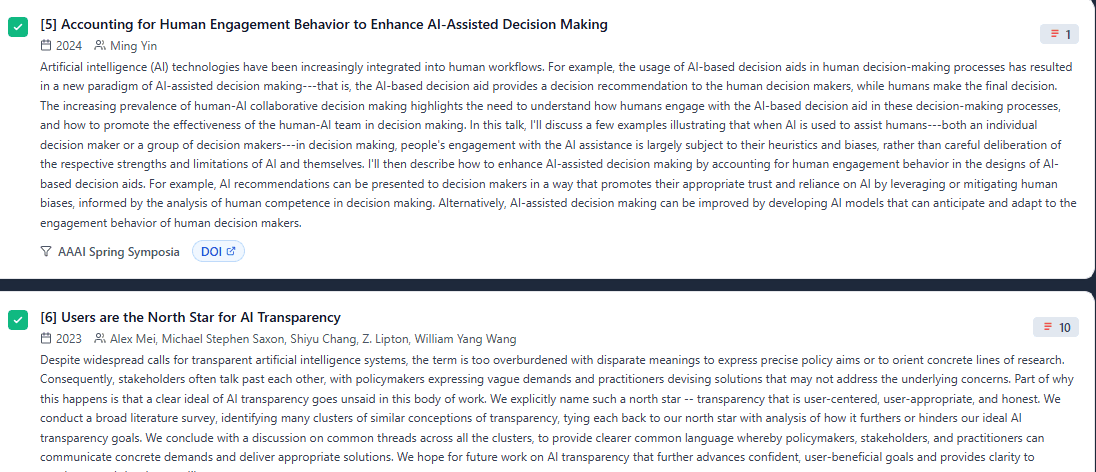
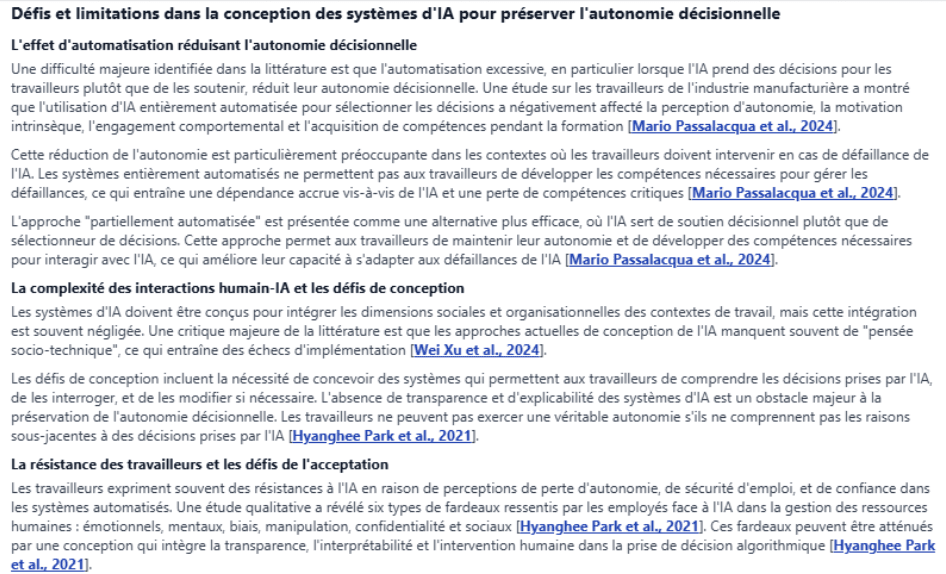
Workers may experience a loss of control when executing decisions they do not understand. Several studies indicate that full automation can reduce engagement and learning, whereas partial automation encourages technological appropriation (Passalacqua et al., 2024; Smith et al., 2024).
Maintaining Decision Autonomy in the Age of Digital Tools
A central concept emerging from the literature is decision autonomy. It refers to the ability to understand, evaluate, and potentially challenge an algorithmic decision.
When systems are opaque, workers may develop cognitive dependency: they either follow the recommendation without analysis or systematically reject it (Grote, 2023).
Toward Human-Centered AI Collaboration
The literature converges on a major shift: the question is no longer whether AI should be used, but how it should be designed.
Human-Centered AI approaches propose placing the user at the core of the system. AI should support human activity rather than replace it.
Impact on Employment and the Transformation of Professions
Contrary to scenarios predicting massive job substitution, research mainly highlights a transformation of roles. New tasks emerge: supervision, interpretation, validation, and arbitration (Fenwick et al., 2024).
Required skills are increasingly oriented toward critical analysis and the management of algorithmic uncertainty.
Co-Design: Involving Workers in the Design Process
Systems designed without user involvement are more likely to fail. Including workers in the design process helps identify real use cases and adapt the tool to professional practices (Böhme & Graf-Pfohl, 2025).
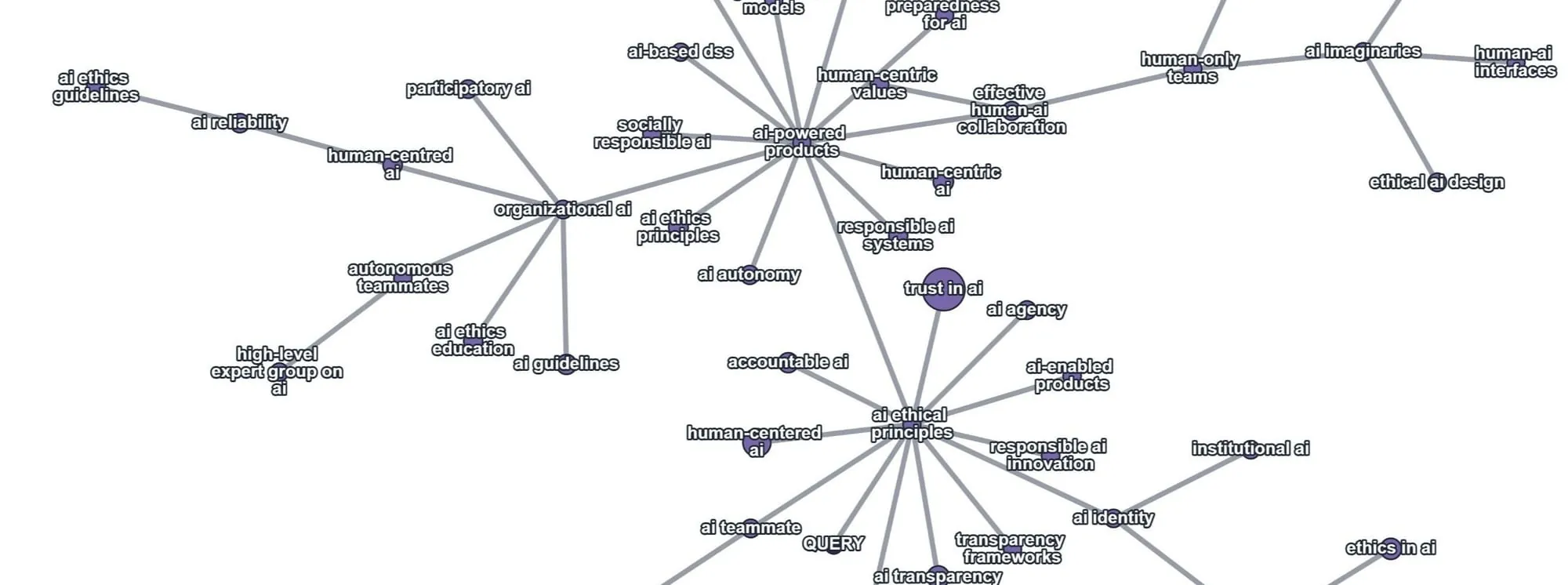
Graphe de connaissance reliant les concepts scientifiques sur la collaboration humain-IA.
The Role of Human Resources in AI Adoption
AI adoption becomes an organizational process. Training and support strongly influence system acceptance. Without understanding how it works, AI is often perceived as a monitoring tool rather than an assistance tool.
Partnership Models Between AI and Human Intelligence
Scientific literature distinguishes several modes of human & AI interaction.
Experience Feedback and Case Studies
Researchers generally identify four main configurations: tool, assistance, collaboration, and full autonomy. Optimal performance usually appears in intermediate models where humans validate the decision.
Augmented Creativity and Hybrid Decision Systems
In complex fields — such as medicine, engineering, or research — human-AI collaboration produces better results than either alone. AI explores possible solutions, while humans interpret and decide.
The Importance of Transparency and Explainability (XAI)
Trust depends on system understanding. Research on explainable AI (XAI) shows that appropriate transparency improves human judgment quality, whereas total opacity leads to rejection or over-confidence (Ngo, 2025; Buçinca et al., 2024; Rozario, 2023).
Conclusion: Achieving Human–AI Synergy
Scientific literature converges on a clear conclusion: organizational effectiveness does not depend on maximum automation, but on balanced cooperation between humans and machines.
AI becomes a cognitive partner that enhances analytical capabilities rather than replacing human decision-making.
NeoPhi enables researchers and organizations to rapidly explore this literature and transform scientific knowledge into actionable insights for research, innovation, and decision-making.
FAQ: AI and Humans at Work
What is the relationship between AI and humans at work?
Artificial intelligence systems are increasingly used as decision‑support tools within organizations. The relationship between AI and humans is generally based on collaboration: the machine analyzes data and generates recommendations, while workers interpret the results, supervise the system, and retain responsibility for decision‑making.
What are the effects of automation on employee autonomy?
Full automation reduces vigilance and learning, whereas decision‑support systems can strengthen skills and autonomy.
How do generative AI and intelligent agents transform jobs?
Generative AI and intelligent agents are transforming jobs by automating certain execution tasks and data analysis activities. Professionals are increasingly involved in interpreting results, supervising systems, and validating decisions proposed by AI. This evolution follows a collaborative AI–human model, in which the machine supports cognitive activity without replacing workers’ decision‑making responsibility.
Why involve employees in the deployment of AI within organizations?
Because acceptance and performance depend directly on employees’ understanding of the system.
What is the impact of AI on productivity and social well‑being?
Productivity increases primarily when AI supports human decision‑making rather than replacing it. The impact on social well‑being depends on how AI is adopted in the workplace.
What role does data transparency play?
Data transparency is a key condition for trust and effective system use. The clarity of the data being processed directly shapes confidence and actual adoption of the solution. For end users, it guarantees a reliable, ethical, and high‑performance service.