
Methodology
State of the Art: Definition, Challenges and Methodology for Successful R&D Strategy
On this page
By Noël Chaumard, PhD in Planetary Sciences from Blaise Pascal University Clermont-II, holder of an Executive MBA from ESSEC, and Project Leader specializing in large organizations at F.initiatives
In the world of research, whether fundamental or industrial, one question keeps coming up: “What do we actually know to date?”
This question is far more than a simple administrative formality. It lies at the heart of research and innovation, across fields as diverse as environment, healthcare, technology, and climate transformations observed in France and worldwide.
As a PhD holder and IT accounts expert at F.initiatives, I have seen this requirement evolve from university laboratories to the R&D strategies of the largest organizations.
In this context, NeoPhi supports R&D stakeholders by facilitating the exploration of scientific publications and the analysis of existing knowledge.
Producing a state of the art means identifying and analyzing the boundary between what is known and what is unknown. This is precisely where a researcher’s added value lies and where a project’s eligibility for funding mechanisms such as the CIR is established.
What Is a State of the Art?
Simple Definition of a State of the Art
A state of the art is a critical and exhaustive synthesis of existing scientific and technical knowledge on a specific topic at a given point in time, based on the analysis of sources, articles, theses, and research work.
Unlike a simple list of readings or a descriptive literature review, it is a cross-cutting critical analysis. Conducting a state of the art does not mean saying “Author X said this, and Author Y said that.” Rather, it means being able to state, for example: “Authors X and Y agree on this point, but their methods diverge on this aspect. This leaves an unresolved area that I aim to explore through my research project or thesis.”
Why It Is Not Just a Bibliography
The Notion of Uncertainty and “Lock” : this concept is extremely important in R&D and in any structured scientific work. The purpose of a state of the art is to identify the scientific or technological lock.
This lock corresponds to the obstacle that current knowledge does not allow us to overcome using conventional methods or existing techniques.
Without a solid state of the art, it is therefore impossible to demonstrate that one is conducting research, as it becomes impossible to prove that the solution was not “obvious” to an expert in the field.
Understanding Scientific Uncertainty
Uncertainty vs. Feasibility: Do Not Confuse “Unknown” with “Impossible” : a fundamental distinction must be made here. The absence of a solution in a state of the art (uncertainty) does not mean that a project is not feasible.
Scientific uncertainty lies in the fact that, based on currently available knowledge and accessible data, we do not know how to achieve the objective or whether the proposed method will work.
Feasibility, on the other hand, is often the result of R&D work itself—demonstrating whether what was initially uncertain can in fact be achieved.
In summary, the fact that knowledge does not yet exist (uncertainty) does not mean that the objective is unachievable. This is precisely where R&D operates: resolving uncertainty through experimentation in order to demonstrate new feasibility.
Why Conduct a State of the Art? Strategic Challenges in R&D?
Beyond scientific validation, the state of the art fulfills three key functions within a research or innovation project:
- Avoiding redundancy: “reinventing the wheel” is the most costly pitfall in R&D and innovation. The state of the art secures investment by ensuring optimal allocation of resources toward genuine novelty, based on the analysis of existing work;
- Credibility and funding: for funding bodies (e.g., Bpifrance, tax authorities for the CIR), the state of the art demonstrates that the company masters its technical ecosystem and available knowledge. It forms the foundation for justifying the novelty of the project;
- Guiding the trajectory: by identifying past failures in scientific literature and research work, the state of the art helps select the most promising approaches, methods, or protocols, thereby anticipating and minimizing risks.
Why Manual Analysis of Publications Is No Longer Sufficient
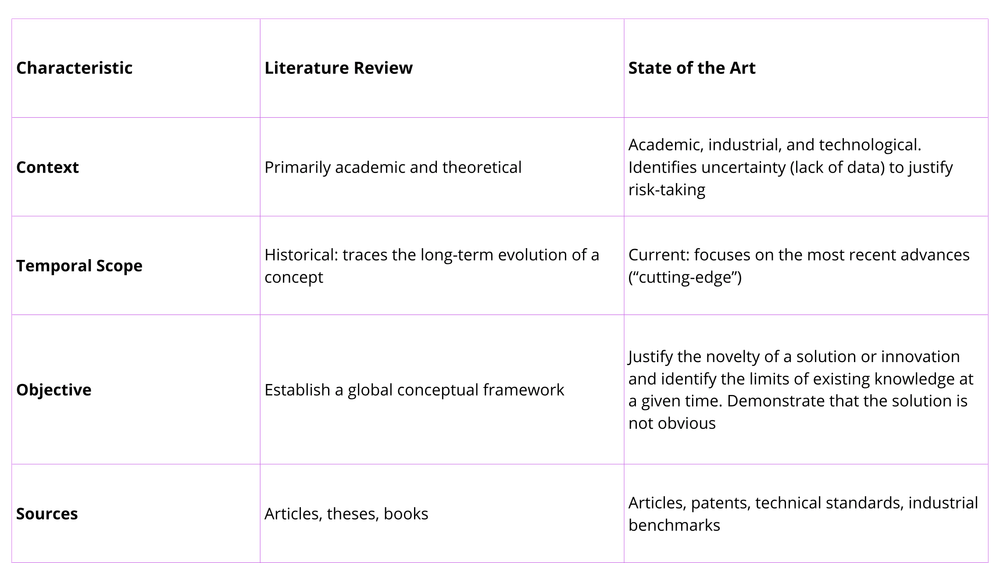
There is often confusion between these two scientific writing exercises. While they share a methodological foundation, their purposes differ:
Why Manual Analysis of Publications Is No Longer Sufficient
The decade I spent studying meteorites and the origin of the Solar System led me to master the rigor required to build a state of the art, particularly in complex research contexts.
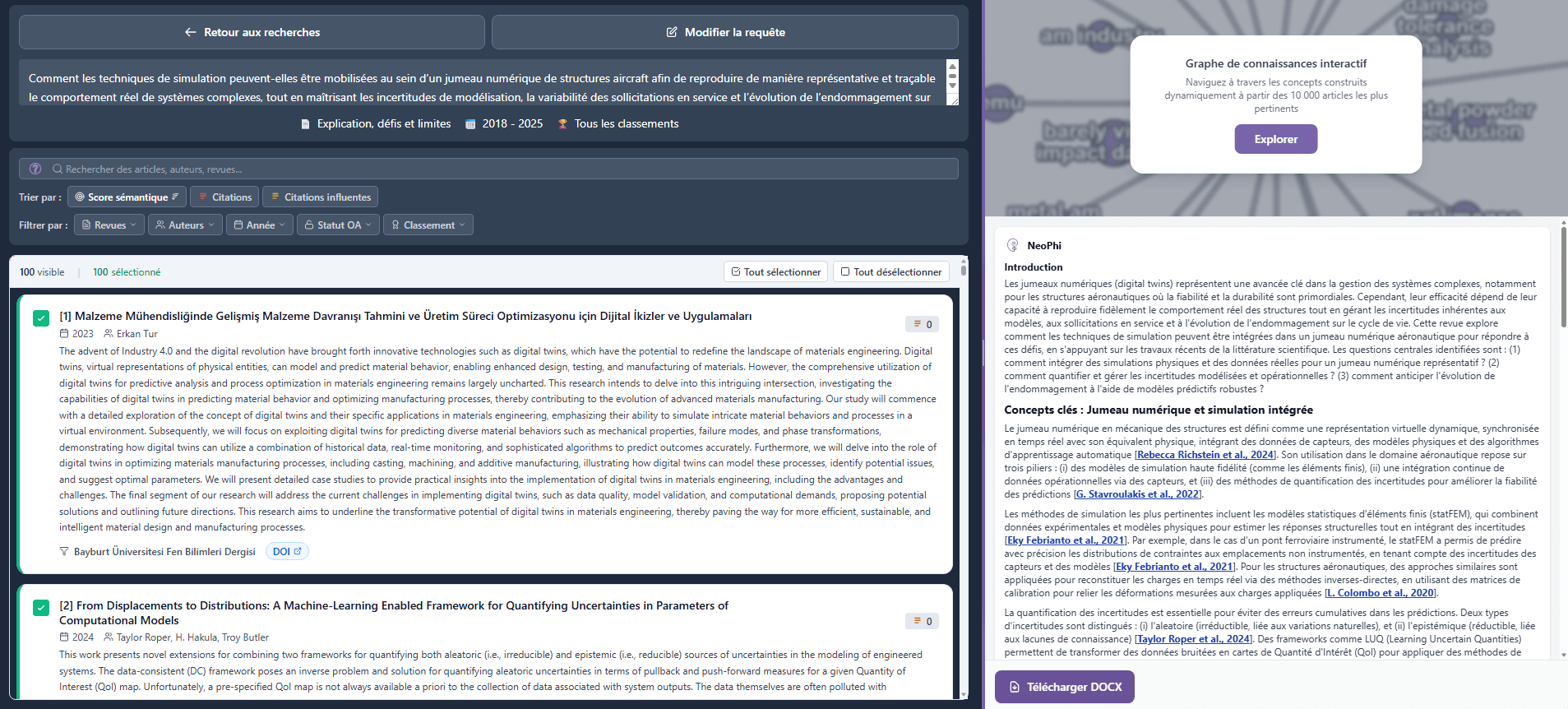
During my involvement in the genesis of the NeoPhi project as an expert in scientific literature review, the challenge was clear: how can we extract meaningful insights and novelty for users from millions of scientific publications and sources?
This is where technology meets methodology. Manual analysis of publications has reached its physical limits given the growing volume of scientific data.
This work highlighted a clear need for semantic tools capable of “reading” and “mapping” knowledge quickly and efficiently.
It is this vision and the desire to address a key friction point in the state-of-the-art process that led to the creation of NeoPhi.
Artificial intelligence does not replace the researcher—it enhances their strategic role by providing structured syntheses of existing knowledge gaps, enabling a shift from passive literature review to a driven R&D strategy.
How to Conduct an Effective State of the Art
To successfully carry out this scientific writing exercise, the following key steps are recommended:
- Define the scope: specify keywords, the research problem, and Boolean operators
- Multi-source collection: go beyond Google Scholar and explore patent databases (Espacenet), preprints, industrial publications, and accessible scientific documents
- Critical synthesis: group works by methodological approach rather than by author
- Gap identification: systematically conclude what is missing or remains uncertain
Common Mistakes to Avoid
- The catalogue effect: listing summaries without real analysis
- Obsolescence: ignoring recent key publications or critical data
- Confirmation bias: selecting only sources that support your hypothesis
- Confusing lock and failure: not citing unsuccessful approaches is a mistake—these confirm uncertainty and strengthen the value of new attempts
Conclusion: A Decision-Making Tool
A state of the art is not a static snapshot—it is a compass within a research or innovation project.
Whether you are a PhD student, a student writing a thesis, or a technical director preparing a CIR file, this exercise is your best safeguard against uncertainty.
With tools like NeoPhi, we are entering an era where scientific knowledge, data, and sources are more accessible than ever. The challenge is no longer to find information, but to interpret it in order to create innovative solutions.
FAQ: State of the Art
What is a state of the art?
A state of the art is a critical and exhaustive synthesis of existing knowledge on a specific topic at a given time. It analyzes advances, debates, and research gaps.
Why is it essential?
It validates scientific credibility, avoids redundancy, and identifies technological locks.
What mistakes should be avoided?
Listing sources without analysis, using outdated data, confirmation bias, and confusing absence of solutions with impossibility.
What is the difference with a literature review?
A state of the art focuses on recent and technical aspects to demonstrate novelty, while a literature review provides a broader historical perspective.
How does AI improve the process?
AI enables rapid analysis of large volumes of publications, extraction of key insights, and faster decision-making in R&D.