Health
From Bench to Pipeline: Self-Supervised Learning for Noisy Biomedical Signals in Pharma and Biotech R&D
On this page
By Saber Graf, PhD in Neuroscience (University of Bordeaux), PharmD, founder of SG AI Solutions
Ask any team building machine learning models on biomedical signals such as ECG, EEG, EMG, LFP, or MEA recordings what limits performance, and most will point to model architecture or dataset size. In many cases, however, the real bottleneck is less visible: label noise. During my PhD, a CNN classifying hippocampal sharp wave ripples plateaued at 73% accuracy no matter how much I tuned it. The problem was not the model. It was the labels. A self-supervised relabeling strategy pushed the same architecture to 84%, a result later validated on ECG and EEG benchmarks (Graf et al., 2025). This article explains how the method works and where it fits within pharma and biotech R&D pipelines, from preclinical safety to real-world evidence.
Why label noise strongly limits biomedical signal models
Supervised learning depends on a simple assumption: the labels are correct. In biomedical signal analysis, that assumption is often fragile. Annotating physiological time series requires domain expertise, and experts do not always agree. Reliable annotation depends on specialists, while subject-to-subject variability introduces label shifts that supervised models struggle to absorb (Weng et al., 2025). Even the definition of the event being annotated can remain unstable. In hippocampal sharp wave ripple research, the lack of a shared operational definition became important enough that a large consortium of laboratories published a consensus statement on how these events should be detected (Liu et al., 2022).
The consequences are substantial. Deep neural networks have enough capacity to memorize mislabeled examples, which harms generalization instead of simply adding a constant error floor (Song et al., 2022). The problem also affects evaluation itself. Northcutt et al. (2021) showed that label errors are widespread in the test sets of major machine learning benchmarks, meaning that noisy labels can destabilize not only training, but also the way models are ranked and selected. In healthcare, where datasets are often smaller and annotation requires specialized expertise, label noise may be even more damaging than in other fields (Karimi et al., 2020).
For pharma and biotech teams, the practical symptom is familiar: a model stalls below expectations despite more data, more tuning, and larger architectures. Before concluding that the useful signal is missing, it is worth asking whether the labels deserve the level of trust the training pipeline gives them.
Self-supervised learning in bioinformatics: contrastive learning, TS-TCC, and the relabeling loop
Self-supervised learning (SSL) learns representations from unlabeled data by solving pretext tasks built from the data itself. In contrastive learning, the model is trained to recognize that two augmented views of the same sample belong together, while views from different samples should be pushed apart in representation space (Chen et al., 2020). For this use case, the main advantage is clear: the training signal does not rely on labels, so the learned representations do not directly inherit annotation noise.
For time series, TS-TCC (Time-Series Representation Learning via Temporal and Contextual Contrasting) is now a recognized reference framework (Eldele et al., 2021). Each signal is transformed using a weak augmentation, such as jitter and scaling, and a strong augmentation, such as permutation and jitter. A temporal contrasting module learns by predicting one view’s future time steps from the other view’s context, while a contextual contrasting module maximizes agreement between contexts from the same sample.
The relabeling loop then proceeds in three steps. First, the SSL encoder is trained on raw signals without labels. Second, the learned embeddings are clustered, typically with k-means, using k = 2 in the binary setting, to generate new labels that better reflect the true structure of the data than the annotator’s original judgment. Third, the supervised classifier is retrained on these SSL-derived labels. If the original labels were clean, performance should stay broadly stable. If they were noisy, the difference between the two training runs directly measures the cost of that noise. In bioinformatics and other medical applications, SSL is advancing because it reduces dependence on expert annotation (Krishnan et al., 2022), and the relabeling loop turns that property into a practical data-auditing tool.
Case study: from 73% to 84% accuracy on sharp wave ripples
Sharp wave ripples (SWRs) are brief high-frequency oscillations observed in hippocampal recordings. They are considered a cognitive biomarker of memory consolidation and planning (Buzsáki, 2015). In this study, the task was to classify SWRs recorded in mice before versus after spatial learning using local field potential recordings from CA1.
A custom 1D CNN trained on the original before/after labels reached 73.28% accuracy under 5-fold cross-validation and then plateaued. The working hypothesis was that a substantial fraction of events labeled according to recording session did not actually carry session-discriminative structure. In other words, the dataset contained meaningful label noise.
Applying the relabeling loop changed the outcome. After 500 epochs of TS-TCC-style SSL training and k-means clustering of the embeddings, the same CNN architecture retrained on SSL-derived labels reached 83.66% accuracy (p < 0.0001). When training was restricted to samples where the SSL labels and the original labels agreed, accuracy increased further to 84.11%, while still being evaluated against the original labels to preserve comparability (Graf et al., 2025).
Two comparisons are especially relevant for practitioners. Against dedicated label-noise methods for time series, the SSL approach outperformed SREA, a self-relabeling method from industrial time-series classification (Castellani et al., 2021), which reached 76.23% (±2.1), as well as CTW, a confidence-based time-warping approach (Ma et al., 2023), which reached 74.52% (±6.8). The SSL result was also the most stable, with a standard deviation of ±1.2 across runs. The code is public, and the scientific paper is open access (Saber-GRAF/ts-ssl-label-noise).
Cross-domain validation on ECG and EEG data
A method validated on only one electrophysiology dataset in one lab is not enough to establish robustness. To test generalizability, the same pipeline was applied to two public benchmarks with controlled synthetic label corruption.
On the MIT-BIH Arrhythmia Database, a standard ECG benchmark (Moody & Mark, 2001), a classifier trained on clean labels reached 98.70% accuracy. When 20% of the training labels were corrupted, performance dropped to 77.75%. The SSL relabeling loop then restored performance to 97.00%, recovering almost all of the loss without changing the test labels.
On the Epileptic Seizure Recognition dataset, built from the classic Bonn EEG recordings (Andrzejak et al., 2001), the same pattern emerged: 98.59% with clean labels, 76.96% with 20% label noise, and 98.02% after SSL relabeling.
The method does have limits, and those limits should be stated clearly. Recovery is strongest when label noise is roughly between 10% and 20%, where the corrected model nearly returns to noise-free performance. It remains useful up to about 30%. By 40% to 50% corruption, however, the clustering step no longer has a reliable majority structure to anchor on, and the method stops delivering meaningful gains. Operationally, that boundary is useful: if SSL relabeling does not improve your model, your labels are probably either already reliable or too degraded for automated correction.
Where SSL fits in a pharma and biotech R&D pipeline
The economics of this method are compelling because it makes use of assets that most R&D teams already have: archives of unlabeled or imperfectly labeled signals. In practice, SSL-based label auditing can fit at several points in the pipeline. In preclinical electrophysiology and safety pharmacology, where compound effects on cardiac or neuronal signals are classified by human annotators or legacy rule-based detectors, the relabeling loop can help quantify and correct annotation drift before models are trained. In digital biomarker development, where endpoints are derived from ECG, EEG, or actigraphy with limited ground truth, SSL pretraining reduces the amount of expert annotation required. In real-world evidence pipelines, where outcome labels are extracted from heterogeneous clinical sources, embedding-based auditing can flag suspicious subsets before they affect downstream analyses.
There are also cases where this approach is not a good fit. First, very small datasets: SSL needs enough unlabeled data to learn usable structure, and a few hundred samples are usually not enough. Second, tasks where label structure does not correspond to separable clusters in signal space, such as subtle ordinal severity grades; k-means relabeling assumes that classes are geometrically distinguishable. Third, regulated settings in which every label change must remain traceable to a human expert. In those cases, SSL outputs should be used as review flags, not as automatic corrections. Under frameworks such as the EU AI Act or GxP validation requirements, traceability matters as much as the accuracy gain.
The central point goes beyond this specific method: data quality work is not just an unglamorous preliminary step before modeling. In noisy biomedical signals, it is often where a large share of performance is determined.
Methodology note
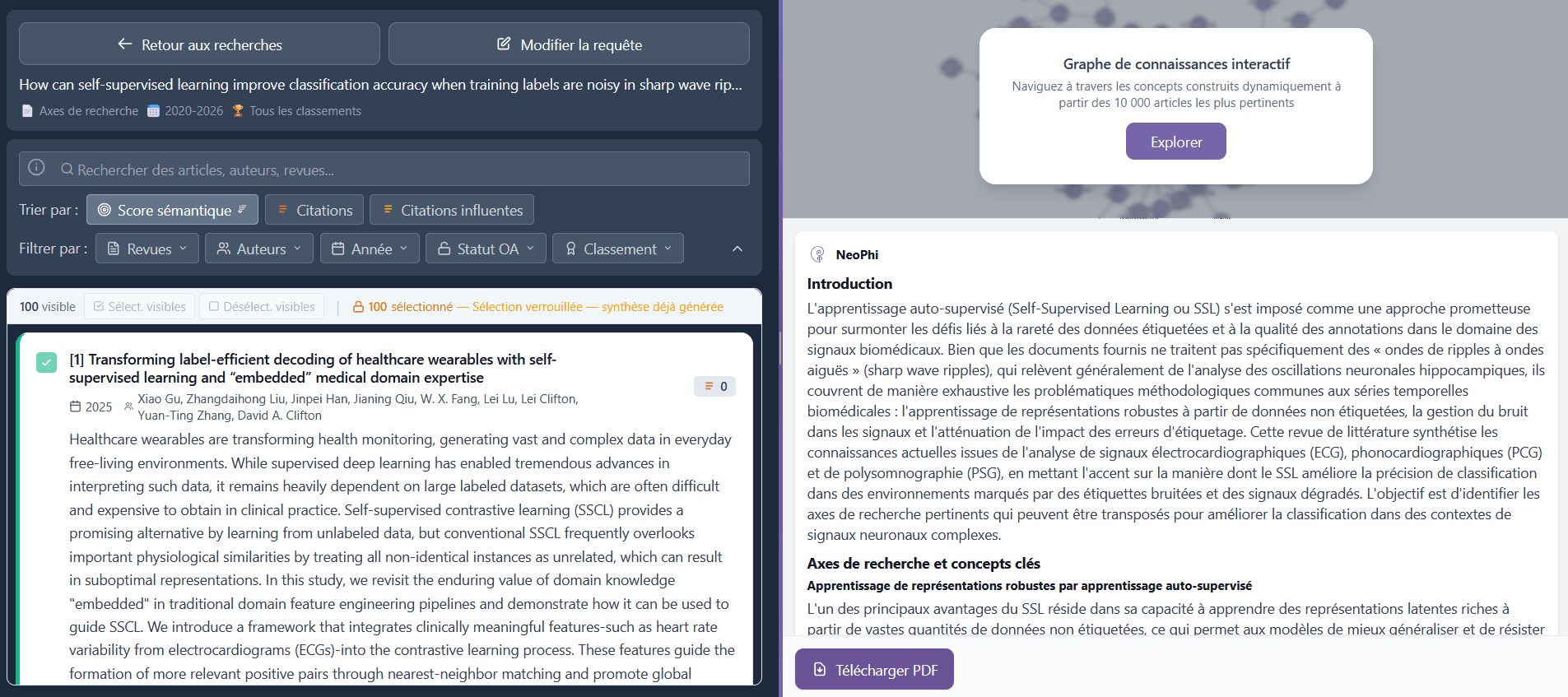
The literature mapping behind this article was built with NeoPhi, FI Group’s scientific intelligence platform. Starting from the research question of how SSL improves classification accuracy when training labels are noisy in physiological signals, including EEG, ECG, and LFP, NeoPhi built a knowledge graph from the 10,000 most relevant publications and produced a structured synthesis from the 100 highest-ranked articles. The platform highlighted recurring research directions in the field, including contrastive pretraining, semi-supervised regularization and pseudo-labeling, masked-autoencoder denoising, uncertainty-aware learning, and domain adaptation. It also surfaced recurring limitations such as annotation scarcity, inter-subject variability, low signal-to-noise ratio, and label ambiguity. These elements helped shape the article. Each primary source was then checked against the original publication before citation.
FAQ
How do I know if bad labels are holding back my model?
A practical first test is to train your model, then apply the SSL relabeling loop and retrain using the SSL-derived labels. If the performance gap between the two runs is significant, that is direct evidence that the original labels conflict with the actual structure of the data. If the gap is small, your labels are probably already reliable, or the noise lies beyond the range where automatic correction remains effective.
Do I need labeled data to use SSL?
No. The SSL pretraining stage requires no labels at all. Labels become necessary only for the final supervised step and for evaluation. That is what makes the method especially attractive for teams with large raw signal archives but only a limited annotated subset.
What is the maximum error rate the method can correct?
In our experiments, correction was most effective when label noise was between 10% and 20%, and it remained useful up to around 30%. It was no longer truly effective around 40% to 50% corruption (Graf et al., 2025). If more than one-third of your labels are wrong, the issue is probably more about data collection or initial annotation than relabeling itself.
Does this method work on signals beyond neural recordings?
Yes. Cross-domain validation included ECG data from MIT-BIH and EEG data from Epileptic Seizure Recognition, with consistent results. The method does not rely on any assumption specific to hippocampal signals and can be applied more broadly to physiological time series, including MEA recordings, EMG, and wearable-derived signals.
Is automated relabeling acceptable in regulated environments?
Not as a silent or fully autonomous correction. In GxP settings or high-risk contexts under the AI Act, SSL-derived labels should be used to flag samples for expert review, with documentation preserving both the original and revised labels. The method speeds up expert review, but it does not replace expert validation.
Where can I find the code and the scientific paper?
The full method is described in Graf et al., Scientific Reports 15, 7647 (2025), open access (DOI: 10.1038/s41598-025-90380-x). The code is available on GitHub at github.com/Saber-GRAF/ts-ssl-label-noise.